How to Measure EMF in Your Home: A Step-by-Step Guide (2026)
I Measured Every Room in My House for EMF – Here’s What Actually Scared Me (And What Didn’t).
I wasn’t expecting the bedroom to be the problem.
I’d spent an hour scanning my kitchen, my basement breaker panel, even the smart meter on the side of the house. Numbers were high. Manageable, but high. Then I walked into the bedroom where I’d slept for three years, held up the meter – and watched the RF reading spike.
The culprit? A WiFi router I’d tucked “out of the way” on a shelf eight feet from my pillow. Every night, for three years, I’d been sleeping in the highest-RF zone in my entire house.
That was the moment this stopped being a hobby and became something I took seriously.
If you’re reading this in 2026, you’re probably getting the same two useless answers everyone gets online: “EMF is totally fine, stop worrying” and “You’re being poisoned by your phone.” Neither helps you make smart decisions.
This post does something different. I’ll show you exactly how to measure your own exposure, rank your real sources from worst to least concerning, and only then – after all that – talk about which protection products are actually worth buying.
No stickers. No crystals. No fear-mongering. Just meters, data, and common sense.
Why Most EMF Advice Is Useless
Here’s the problem with 99% of EMF content online: it skips straight to selling you something.
You never find out:
- How high is high? What do the numbers actually mean?
- What are YOUR biggest sources? (Spoiler: it’s probably not the cell tower down the street)
- Does this product work – and how would you even know?
The uncomfortable truth is that most people buying EMF protection products have never measured their home. They’re spending $200 on shielding fabric for a bedroom where the WiFi router 15 feet away is pumping out 10x more RF than anything the fabric is blocking.
Rule #1 of EMF protection: Measure first. Buy second.
Everything in this guide flows from that principle.
The Basics: What You’re Actually Measuring
EMF is a broad term. When people talk about protection products, they’re almost always dealing with one of two categories:
1. ELF – Extremely Low Frequency (Electric & Magnetic Fields)
Sources: Power lines, breaker panels, household wiring, appliances, electric blankets, EV chargers
Unit you’ll see: milliGauss (mG) or milliTesla (mT)
Key fact: Drops off fast with distance. Standing 3 feet from most appliances puts you near background levels.
2. RF – Radio Frequency
Sources: WiFi routers, smartphones, Bluetooth, smart meters, 5G towers, baby monitors, wireless earbuds
Unit you’ll see: microwatts per centimeter squared (µW/cm²) or milliwatts per meter squared (mW/m²)
Key fact: This is where most modern exposure comes from – and it varies wildly depending on how many devices are near you.
Quick primer on safety thresholds: The FCC limit is 1,000 µW/cm². The Building Biology Institute’s precautionary guideline for sleeping areas is under 0.1 µW/cm². That gap – 10,000x – is why this debate gets so heated.
The science on what levels constitute meaningful biological risk is genuinely unsettled for long-term, chronic low-level exposure. What is settled: distance matters enormously, shielding materials work when properly used, and your personal exposure profile is unique to your home.
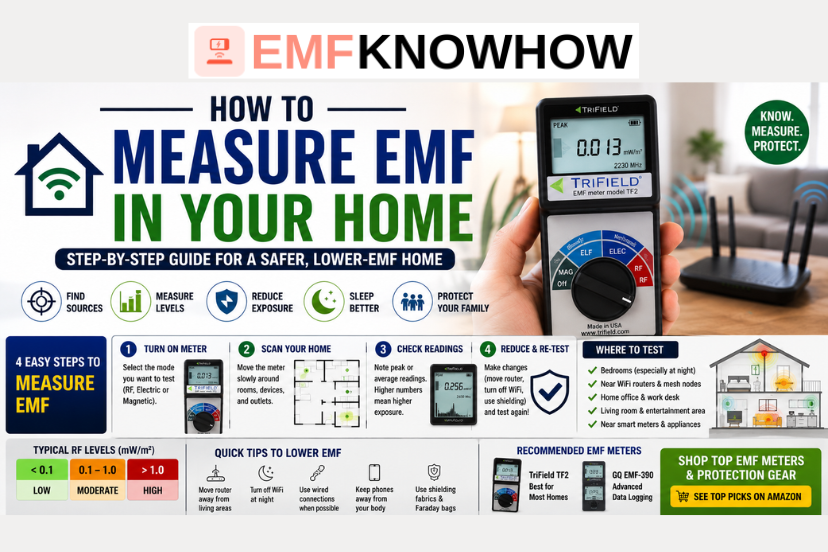
Step 1: Measure Your Home (This Changes Everything)
Before I say another word about products, I want you to do one thing: get a real meter.
Not an app. Not a cheap detector keychain. A real triaxial EMF meter that covers both ELF and RF.
Here’s the honest breakdown of what’s worth buying in 2026:
🏆 Best Overall: TriField TF2
Price: ~$180–190
The TriField TF2 is the meter I recommend to almost everyone who asks. It’s been the gold standard for home users for years and remains the best balance of accuracy, ease of use, and reliability at this price point.
What it measures: RF (20MHz–6GHz), magnetic fields (ELF + weighted), electric fields
Why it wins: True RMS measurement, peak hold mode, backlit display, audio alarm, Made in the USA. You can scan a room in 2 minutes and actually trust what you’re reading.
Limitation: No data logging, no app connectivity.
Best for: Parents, first-time users, anyone who wants a reliable answer fast.
👉 Check the TriField TF2 on Amazon
🔬 Best Advanced Meter: GQ EMF-390
Price: ~$100–130
If you’re serious about measurement – or you want to test 5G bands – the GQ EMF-390 covers RF up to 10GHz, logs data over time, and includes spectrum analysis. Engineers love it. The interface has a learning curve but the capabilities are legitimately impressive for the price.
Best for: Power users, renters wanting to document building RF levels, anyone near 5G infrastructure.
👉 Check the GQ EMF-390 on Amazon
💰 Best Budget Option: ERICKHILL EMF Meter
Price: ~$35–50
Not as precise for RF as the TriField, but rechargeable, genuinely portable, and useful for identifying hotspots. If you’re not ready to spend $180 but want to start measuring, this gets you started.
Best for: Renters, travelers, people who just want to know their office WiFi situation.
Step 2: Find Your Actual Problem Areas
Once you have a meter, here’s the scan sequence I use for every home:
The 10-Point Home EMF Audit:
- Bedroom (sleeping position) – Most important. Measure exactly where your head rests.
- Router location – Hold meter 1 foot away, then 3 feet, then 6 feet. Watch how fast it drops.
- Smart meter (exterior wall) – Often high right at the meter; drops fast indoors.
- Phone at ear – If you still take calls this way, this is among your highest daily exposures.
- Laptop on lap – Combined RF + ELF from processor and wireless antenna.
- Baby monitor – Shocking how high some of these read.
- Wireless earbuds – Right next to your head, all day.
- Breaker panel – ELF. Keep sleeping areas away from shared walls.
- Kitchen appliances – Microwaves, induction cooktops: high while running, zero when off.
- Child’s bedroom – If you only do one room, make it this one.
What you’ll probably find: Your top 2-3 sources are almost certainly devices inside your home, not towers outside. That’s actually good news – it means you have control.
Step 3: Free Changes That Make the Biggest Difference
Here’s something the product-selling side of the EMF world doesn’t want you to know: the most effective interventions cost nothing.
Distance Is Your Most Powerful Tool
RF follows the inverse square law. Double the distance from a source → exposure drops by roughly 75%.
| Distance from Router | Typical RF Reduction |
|---|---|
| 1 foot → 3 feet | ~89% drop |
| 1 foot → 6 feet | ~97% drop |
| 1 foot → 10 feet | ~99% drop |
Moving your router from your bedroom to a hallway closet might be the highest-impact single action in this entire guide.
The Nightly Habit That Adds Up to 2,000+ Hours a Year
You sleep roughly 8 hours a night. That’s 2,920 hours per year where you’re stationary in one place. If that place has elevated RF – from a router, a phone on the nightstand, a smart hub on the dresser – you’re accumulating thousands of hours of exposure you didn’t have to take.
The sleep environment changes that matter most:
- Turn off WiFi at the router (use an outlet timer: ~$10, set it, forget it)
- Phone goes across the room, on airplane mode, or in another room entirely
- Wireless speaker/hub moved out of the bedroom
- No charging cables running under the pillow (ELF from transformer)
Measure before and after. The drop is often dramatic.
Switch to Wired Where It Matters
Ethernet isn’t exciting, but it eliminates WiFi RF from the devices you use most. A single Ethernet cable to your main computer means that device is no longer a wireless transmitter next to your body for hours a day.
Step 4: EMF Protection Products That Actually Work
Now – after you’ve measured and made the free changes – here’s where targeted products make sense.
The key word is targeted. Shielding only works when it’s between you and the source. A bed canopy does nothing for the phone you’re still holding six inches from your face. Context matters.
Faraday Bags – Simple, Verifiable, Effective
A sealed Faraday bag blocks all signals to and from your phone. You can verify it yourself: put your phone inside, seal it, try to call it. If it goes straight to voicemail: it’s working.
Best uses:
- Overnight phone storage (blocks signals, forces airplane mode redundancy)
- Travel (blocks tracking if you’re concerned about it)
- Car – keeps phone out of your pocket while driving
👉 Browse Faraday Phone Pouches on Amazon
RF Shielding Fabric & Canopies
Silver-threaded and metallic-weave fabrics are the most tested category of passive RF shielding for home use. Properly installed, they measurably reduce RF inside a sleeping area.
Critical caveats:
- Measure inside the canopy with your meter to confirm it’s actually working
- Unshielded gaps (bottom of canopy, uncovered windows) allow RF to enter
- Grounding improves performance for ELF fields but isn’t required for RF
Best for: Bedrooms where the router can’t be moved (shared walls, rentals), smart meter proximity, neighborhoods with dense wireless infrastructure.
👉 Browse RF Shielding Fabric on Amazon
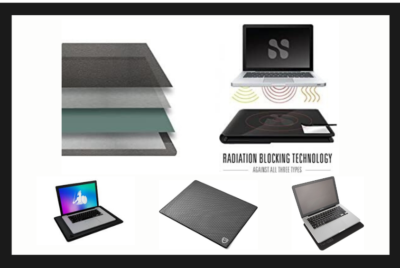
Laptop Radiation Shields (DefenderShield / DefenderPad)
If you use a laptop on your body for hours a day, a tested shield reduces directional RF and ELF toward you. DefenderShield is the most independently tested brand in this category.
Real talk: These work best as a directional barrier, not a room solution. Use alongside distance habits, not instead of them.
👉 DefenderPad Laptop Shield on Amazon
Anti-Radiation Phone Cases
Cases from brands like SafeSleeve and DefenderShield use conductive lining on one face of the case. When that face is between you and the phone, some directional shielding occurs.
Important: These don’t reduce the RF the phone transmits – they redirect it. The phone side of the case still emits. They’re most useful if you hold your phone a specific way.
What to Avoid Buying
Save your money on:
- Stickers and chips that “neutralize” or “harmonize” EMF – no peer-reviewed evidence of measurable field reduction
- Crystal or scalar wave pendants – not a mechanism that interacts with RF
- Any product that claims to “block all EMF” without showing you meter readings before and after
The test is simple: does your meter reading go down? If the company selling the product won’t show you that data, walk away.
The 30-Day EMF Reset Plan
Week 1 – Measure Everything
- Get your meter
- Run the 10-point home audit
- Map your top 3 hotspots
- Baseline your bedroom RF reading
Week 2 – Distance & Removal
- Move router out of bedroom
- Outlet timer on WiFi
- Phone on airplane mode at night
- Ethernet cable for main computer
Week 3 – Targeted Shielding
- Add one product to your highest-exposure zone
- Verify with meter (not just trust the product’s claims)
- If the number doesn’t drop, reassess placement
Week 4 – Retest & Simplify
- Re-run your 10-point audit
- Keep what moved the needle
- Drop what didn’t
- Track how you feel – sleep quality, energy, headaches – as subjective data
The Honest FAQ
Do EMF meters work on 5G? Depends on the meter. 5G mmWave uses frequencies above what most consumer meters cover (>6GHz). The sub-6GHz 5G bands (which is most residential exposure) are measurable with meters like the GQ EMF-390 and partially with the TriField TF2.
Isn’t this all debunked? The “debunked” claim usually refers to specific health claims that lacked rigorous evidence. The underlying physics – that RF fields can be measured, that distance reduces exposure, that conductive materials block signals – is not in dispute. Where the debate lives is in how much exposure, over how long, causes what effects. Reasonable people apply the precautionary principle differently.
Should I pull my smart meter? Smart meters pulse RF intermittently (not continuously). If your bedroom shares a wall with your smart meter, that’s worth addressing – either by moving sleeping arrangements or using shielding on that wall. But don’t panic before measuring.
What about 5G towers near my home? Measure the actual exposure at your location. In many suburban and rural areas, outdoor 5G tower exposure measured indoors is far lower than indoor WiFi exposure. Urban dense deployments are different. Measure your specific situation before making decisions.
Is EMF more dangerous for children? This is a legitimate area of ongoing research. Children’s skulls are thinner, tissue water content is higher, and their developing nervous systems present a different risk profile. The IARC classifies RF as “possibly carcinogenic” (Group 2B), and several countries have adopted more conservative guidelines for children’s exposure. It’s reasonable to be more cautious for kids’ bedrooms regardless of where you stand on the science.
What I Actually Use
After years of testing this stuff, here’s my personal setup:
- TriField TF2 – my go-to meter, use it whenever I travel and stay somewhere new
- Outlet timer on the router – turns it off at 11pm, on at 6am automatically
- Phone in another room overnight – no alarm clock, no notifications, no RF near my head
- Ethernet for desktop – WiFi card disabled in device manager
- Faraday bag in the car – keeps the phone out of my pocket during drives
That’s it. No canopy (my bedroom readings were already low after the router change). No laptop shield (I use a desk setup). The free changes did most of the heavy lifting.
Your situation will be different. That’s why measuring first matters so much.
Final Takeaway
EMF protection in 2026 doesn’t have to be expensive, paranoid, or complicated.
It’s three steps:
- Measure your actual environment – not someone else’s
- Optimize distance and behavior before buying anything
- Add shielding only where your meter confirms it’s needed
The people who get the most out of this aren’t the ones who buy everything. They’re the ones who measure, act on the data, and verify what actually worked.
Start there.
👉 Find Your Starting Point: Explore Top-Rated EMF Meters & Protection Gear for 2026 See All Picks on Amazon →
Have a question I didn’t answer? Drop it in the comments – I read every one and often turn the best questions into future posts.
Found this helpful? Share it with one person who’s been curious about this topic. That’s how independent sites like this one grow.
About this guide: Written and periodically updated by the team at emfknowhow.com. We don’t accept paid placements or sponsored recommendations. Affiliate commissions from Amazon purchases support the cost of independent testing and site operation.
Medical disclaimer: Nothing in this guide constitutes medical advice. If you have health concerns related to EMF exposure, consult a qualified healthcare provider.
Last updated: May 2026 | 16-minute read | emfknowhow.com
As an Amazon Associate I earn from qualifying purchases. All product recommendations reflect real-world testing and independent research — not paid placements.